
Tenacity, the Key to the Writing Life

I began reading Louise Glück’s poems around the time I handed in the final draft of my first book. Now I can see that the book was a culmination of a decade of work and obsession, but at the time, without the manuscript to anchor my thoughts, I felt adrift. I had to come down from the high of achieving what I had set out to do and had to face the blank page again. For a year, I plunged into another project, until I realized that I was rewriting my first book and that I did not yet have the depth and experience to give the new story the justice it deserved. For another year, I hardly wrote at all. I had a few real life adventures, but for the most part, I felt that I was waiting at my desk for words that would not arrive. Without my usual way of expressing what I saw and felt, it seemed to me that the world had lost its texture
Read more…
How To Write Fiction As A Non-Fiction Author
Do you write non-fiction but secretly want to write a novel?
 Are you confused about the process? Do you think you’re not creative enough, or worry that you don’t have enough ideas?
Are you afraid that writing a novel might be a waste of time with no return on investment or practical use in your business?
http://www.thecreativepenn.com/2017/02/15/write-fiction-as-non-fiction-author/
Three Ways to HOOK a Reader & Never Let GO. #3chicksbooks

How do we sell our stories? That is the big question. It is the reason for craft classes and editing and cover design and agents and editors and all the time on social media. And while platforms and covers and algorithms do matter, there is one tried and true way to sell more books.
Write a great story.
And not just any story, but a story that hooks from the very beginning and only continues to hook deeper
https://warriorwriters.wordpress.com/2017/02/22/three-ways-to-hook-a-reader-never-let-go/
New On The Blog: How to Create a Dynamic Story That Will Blow Your Readers Away
Have you ever read a book that just fell flat?

The author didn’t necessarily do anything wrong. They created strong characters, killer conflict and a clever plot, beautiful scene descriptions, and so on. But still the book fell short for you, and you just can’t place your finger on what could have made the story more dynamic.
“Eh, it was just a bit formulaic,” you say when a friend asks how you enjoyed your latest read.
Today, I’m here to make the case that disappointing stories aren’t the result of sticking too closely to story structure (or to any other established writing techniques, for that matter), but rather sticking too closely to the basics of those techniques.
Vague statement. I know.
But I’m going to explain everything you need to know about how we, as authors, can move beyond the basics and elevate our stories into a realm of dynamism that will knock our readers’ socks off.

The Evolution of Sex Writing #3chicksbooks
In setting out to write Future Sex, Emily Witt 
I hoped to define what she once considered an “interim state”: the sexual identity of being a single woman unconstrained by long-term reciprocated love and partnership. The language used to describe relationship statuses within this state, such as the too all-encompassing “dating” and outdated “lovers,” she argues, has lost its meaning in the 21st century. This leads her to another query—perhaps this state isn’t so interim after all
http://lithub.com/the-evolution-of-sex-writing/

Immersive POV #writerunboxed @ #3chicksbooks
 Every fiction writer beyond the beginner stage knows about point-of-view. It’s the perspective from which a story is told. It’s the eyes through which we are seeing, the ears through which we are hearing, the mind through which we’re processing, the heart through which we’re feeling.
POV is mostly the protagonist’s, but it can also be any other character’s (as in multi-POV), an observer’s (think Nick Carraway), or even the author’s. The prime directive of POV is also well known: keep it consistent, no head hopping within a scene
My Writing Process @phettehollins | #3dchicks
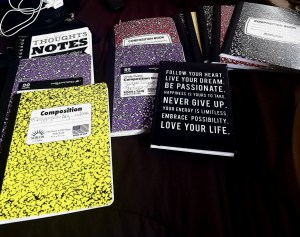
Notebooks Galore
Creativity hits me several times a day. I can see something while I’m out and about, overhear a conversation, or be involved in a conversation, hear a funny line & say “I’ma put that in my script.” I say that a lot.
When this happens and if I’m away from home, I write a note in my Memo app or in Evernote. If I am home, I decide if the “idea” already has its own notebook. If it does, I write it in there. If not, I break the idea down even more. If the idea needs its own notebook, I designate one.
I have notebooks for everythang. I have one that’s primarily for my brand. I have one where I outline blog posts, jot down ideas in a hurry; it’s a catch all book, and also the book I used to outline this post. 🙂
Other than that, each project has its own notebook.

Once it’s in the notebook, then I brainstorm, free-write whatever comes to mind, organically & naturally, about the characters, the story, or whatever. I do this for as long as the creativity flows. And when it’s done, it’s done. I absolutely do not force it. I step away for a day or so and re-visit, if necessary.

Next, I look to see if there’s enough information for a story…which there usually is. To rephrase, the real question is: What type of story does the information yield? A short story, a novel, novella, a series? You can always add, takeaway, or do whatever your heart desires. That’s the beauty of writing and story telling. When there’s a will, there’s a medium. 🙂
A Beginning, Middle, and an End

This is an example of how I separate my story. This one is blank because, it just so happens that, this particular story came to me so quickly that I actually wrote the entire story in a day. No outline. No nothing.
From here, I just write the story to the end, without looking back until I’m ready to edit. I do not edit as I go. I repeat, DO NOT EDIT AS YOU GO! It drastically slows down the process. Took me 2 years to write my second book, because I was obsessing over stuff. Just write it. You’re welcome!

- Edit
- Proofread
- Edit summore
- Proofread
- Proofread summore
- Publish

HAPPY WRITING!!!
Writers’ manifesto for 2017 – take your imagination seriously

 A lucky turn of the radio dial this week and I got a real treat: the Radio 2 presenter Jeremy Vine interviewing Brian Eno. The whole piece is worth listening to, but this exchange particularly caught me.
Vine was trying to pin down what made some of Eno’s collaborators so special – David Bowie, David Byrne, Bryan Ferry. He said this: they all had ‘a different quality of imagination’.
And Eno replied: ‘I think everyone has much more imagination than they give themselves credit for. But the difference is that some people take their imaginations seriously.’
Yes. One thousand per cent.
Today, I’d planned another kind of post. Usually my new year kick-off is publishing options for twenty-whatever. I began to write it. I realised as I did that not much had changed. What I’d say for 2017 is much the same as I’d said in 2016. And…
View original post 306 more words





 3 Chicks and Some Books